Tourisme Bas-Saint-Laurent

My Favorites

Parc côtier Kiskotuk

In the Forest, at the Roots of History

Laura Martin, rédactrice

Writing

Laura Martin, she shares her crushes and discoveries with us for our greatest happiness!

Article published on

For thousands of years, First Nations travelled through the forests of the Bas Saint Laurent, fished in its rivers, and set up their camps here and there. Today, it is still possible to walk in their footsteps. In the region’s parks, some trails quite literally allow us to travel back through time. Each step forward takes us back into the past, to meet those who lived in these places long before us. Not a boring hike… as long as we are not in a hurry!

Parc national du Lac-Témiscouata

The ground of Parc national du Lac Témiscouata is much more than a carpet of roots and pine needles: it is a true buried history book. More than fifty archaeological sites have been discovered there, proving that these places were already frequented by Indigenous peoples around 10,000 years ago. At the time, nomadic groups travelled through the forest in search of food and raw materials, including chert, a stone ideal for making hunting tools.

Témiscouata-sur-le-LacMathieu Dupuis

Today, while walking through the Jardin des mémoires beneath the tall pines, all it takes is a short pause to imagine the lives of these ancestors, shaped by the rhythm of the seasons. The site also tells the story of another era, that of the loggers and log drivers, who in turn came to shape the territory. In summer, immersive activities, such as rabaska excursions or guided archaeological digs, even make it possible to go from tourist… to explorer.

Parc national du Bic

At Bic, the trees conceal centuries of history. Long before the arrival of settlers, Indigenous camps were established there nearly 8,000 years ago. Then, starting at the end of the 17th century, fishermen and fur traders settled there, followed by forestry workers in the 19th century.

Parc national du Bic, RimouskiPatric Nadeau

Over time, the site successively became a strategic post for the defence of New France, a pilotage station for navigation on the St. Lawrence, and later an agricultural territory.

Today, by taking the archaeological trail accessible via Chemin du

Nord, it is possible to discover these different layers of occupation. Maison Feindel, with its exhibition Regards sur le passé, also invites visitors to retrace the course of history.

Parc côtier Kiskotuk

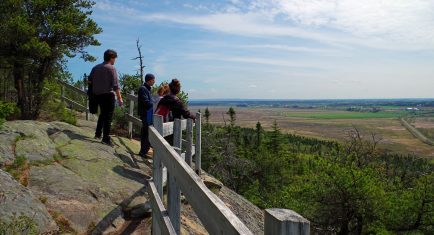
We are not the first to marvel at the breathtaking views offered by this park around the Gros Cacouna marsh. Oh no! Many others admired them long before we did… For millennia, the Wolastoqiyik Wahsipekuk First Nation practised hunting and fishing there, taking advantage of the abundance of the environment.

Parc côtier Kiskotuk

Even today, by taking the time to stop, their presence can still be felt. The park features a few interpretive panels, particularly at the rest area between the Passereaux and Roitelets sectors, to better understand this rich culture that shaped the territory and continues to accompany our steps.